
How to Implement a Reflection Log in Your Language Classroom
At the end of every class , my students pull out a simple one-page template, grab a pen, and spend five minutes reflecting on their participation and learning. They photograph or scan their handwritten entries and upload them to our learning management system. It's decidedly low-tech, takes minimal time, and has given me insights into my students brains, how they experience the class, and what they are getting from it.
I call it the Practice & Progress Log, and after implementing it for several semesters with consistent student buy-in and concrete improvements in participation, I'm convinced this reflective tool deserves a place in more language classrooms.
Why "Practice & Progress"?
The name itself communicates the pedagogy behind this reflection tool:
Practice acknowledges that language learning requires repeated, intentional effort. Every class is an opportunity to try, fail, adjust, and try again. There's no perfection, only practice.
Progress reminds students that growth isn't always linear or immediately visible, but it is happening. Sometimes progress looks like speaking more; other times it looks like listening better or helping a classmate find their voice.
Log signals that we're tracking this journey systematically. It's a consistent record that students can look back on to identify patterns, celebrate growth, and set concrete goals.
Together, these three words frame language learning as an ongoing, documented process rather than a series of isolated performances.
The Template
The Practice & Progress Log uses a standardized template with eight reflection prompts. Here's what students complete after every class:
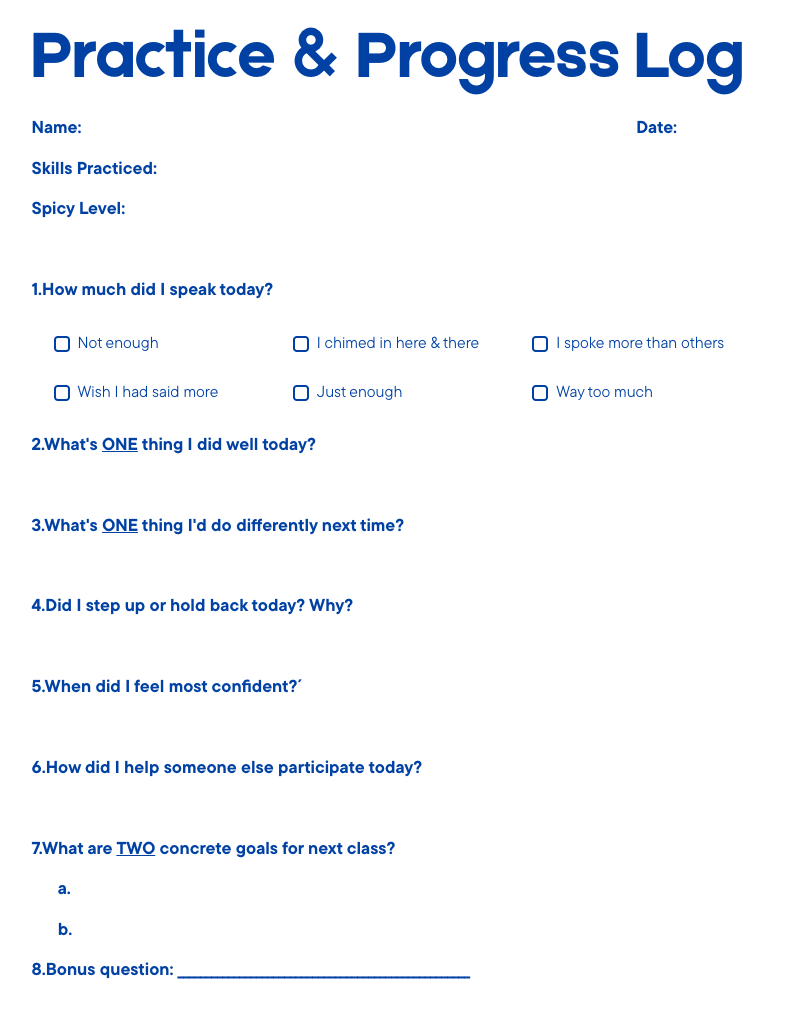
Bonus question: This flexible space allows for session-specific reflection, peer questions, or student-generated inquiries.
The Spicy Level
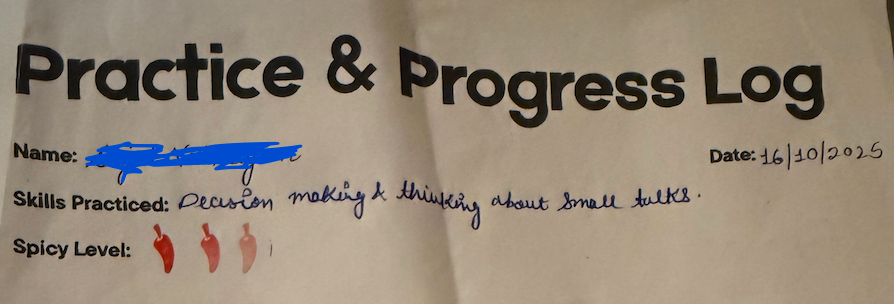
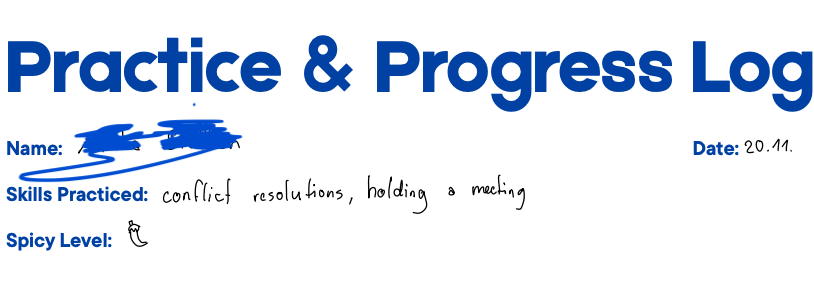
One of the most popular features of the Practice & Progress Log is the Spicy Level, a simple 1-3 chili pepper scale (🌶️) that students use to rate how challenging the class activities felt to them. Another reason this part is beloved is because I bought tiny chilli stamps and red ink that they can stamp. Personally, I find it adorable. Shout out to my mom for scouring Berlin to find the ink! Thanks :)
How It Works
Students select how many peppers represent their challenge level that day:
🌶️ (Mild): Comfortable, within my abilities
🌶️🌶️ (Medium): Challenging but doable, pushed me a bit
🌶️🌶️🌶️ (Spicy): Really difficult, way outside my comfort zone
For example, in a meeting participation activity, the levels might look like this:
🌶️ (Mild): Say "Thank you for that idea" or "Good point" to someone
🌶️🌶️ (Medium): Add to someone's idea by saying "I agree, and I think we could also..."
🌶️🌶️🌶️ (Spicy): Politely tell someone their idea won't work: "I appreciate the suggestion, but I don't think that would be effective because..."
Why the Spicy Level Matters
This metacognitive exercise helps students:
Recognize their comfort zones and identify where they're ready to stretch
Track their progress over time (what felt like 3 peppers in October might feel like 2 peppers in December)
Communicate difficulty to me without feeling like they're complaining
Celebrate risk-taking when they intentionally choose spicier challenges
The visual metaphor is intuitive, fun, and provides me with valuable data about which activities push students productively versus overwhelm them.
Ok, But Why Handwriting?
In an age of digital everything, requiring handwritten reflection might seem counterintuitive. So why insist on pen and paper?
Slowing Down the Thinking Process
Research consistently shows that handwriting engages the brain differently than typing. According to Lambert (2024), handwriting activates brain connectivity patterns involved in memory formation and learning that typing doesn't trigger. Research in Frontiers in Neuroscience found that the physical act of forming letters by hand creates stronger neural pathways.
When students type, they can transcribe their thoughts almost as quickly as they think them. When they write by hand, they must slow down, select their words more carefully, and engage more deeply with the reflection process.
For language learners specifically, this cognitive engagement is crucial. Reflection helps record what happened, but more importantly, helps processing the learning experience, consolidating new language structures, and making meaning from classroom interactions.
Important note: Students do photograph or scan their handwritten logs to submit them digitally, but that initial handwritten reflection is where the cognitive benefits happen.
Making It Work in Your Classroom
Here's what I tell students at the beginning of the semester:
Practice & Progress Log Requirements:
Complete a handwritten reflection after every class
Upload a photo or scan to the learning management system
Submit 10 complete entries total throughout the semester. The amount is about 30% less than the amount of classes we have in the semester to acount for absences.
All entries due by [end of semester date]
This is required to take the final exam
That last point is crucial. The Practice & Progress Log is a foundational component of the course. It sn't optional extra credit. Students who don't complete their logs aren't eligible for the final exam. This policy ensures consistent engagement throughout the semester.
Time Management
For students: They complete the log after during the last 5-min of class.
For instructors: I don't grade them in the traditional sense. I check for completion, skim for patterns, engagement, and growth. I might leave a brief encouraging comment on a few entries, particularly if their reflections are bit superficial. I'm do not provide detailed feedback. I typically spend 30-45 minutes mid-semester and again at the end reviewing each student's complete collection of logs.
Digital Submission
Students use their phones to photograph their handwritten pages or scan them at home. They upload to our LMS (I use Moodle, but any platform works). This system:
Preserves the cognitive benefits of handwriting
Creates a digital archive students can review anytime
Makes submission convenient
Allows me to review logs from anywhere
You could absolutely have them store them in a paper folder, but I find that they are often lost.
Getting Started
Ready to implement this in your own classroom? Here's a simple roadmap:
Step 1: Create Your Template. Make your own version of the template. You can use my eight questions as-is or modify them slightly to fit your course objectives (Click here to access it on Canva). Decide on your "Spicy Level" descriptors based on typical activities in your class.
Step 2: Introduce It Clearly. On day one or two, explain the purpose, requirements, and deadline. Emphasize that this is a growth tool, not a punitive measure. Be clear about the handwriting requirement and briefly mention the research behind it.
Step 3: Model It (Optional). Consider completing a Practice & Progress Log yourself after the first or second class and sharing it with students. This demystifies the process and shows you're participating in the reflection too.
Step 4: Collect the First Round. After class 2 or 3, have students submit their first log. Review them quickly and provide brief, encouraging feedback to set the tone. This helps students understand the level of reflection you're looking for.
Step 5: Check In at Midterm. Around week 5-6, ask students to review their logs so far and identify patterns. What do they notice about their participation? Their confidence? Their goals? This metacognitive review deepens the learning.
Step 6: Use the Data. Let the logs inform your teaching. If multiple students struggle with the same thing, address it. If students consistently mark certain activities as 🌶️🌶️🌶️ and report feeling overwhelmed, you know you need to scaffold differently.
Step 7: Celebrate Growth. At the end of the semester, ask students to write a brief final reflection comparing their first log to their last. Many students are genuinely surprised by how much they've grown.
Common Questions
"What if students forget to complete their logs?"
Then, they need to catch up, go back and review what they did. You can also build in regular reminders. Or like I do, dedicate the last 5 minutes of class for log completion. You could also have students to reflect after class when they've had time to process.
"What about students with disabilities that make handwriting difficult?"
Of course provide accommodations for students with documented needs. The handwriting requirement is about cognitive engagement, not creating barriers.
"Do I have to use all eight questions?"
No! Adapt the template to your needs. Use 5 questions, use 10. You do you! The key is consistency. Use the same template throughout the semester so students can track patterns.
"Can this work in online/hybrid classes?"
Absolutely. The process is identical. Students handwrite their reflections and upload photos/scans. In fact, it would be great for online contexts where you have less visibility into student engagement.
Final Thoughts
The Practice & Progress Log is not flashy. It doesn't require expensive technology or elaborate training. It's just a single sheet of paper, a pen, and eight questions.
But in that simplicity lies its power.
I know this sounds corny, but the Practice & Progress Log tells students: Your learning matters enough to document. Your progress is worth noticing. Your participation impacts others. Your reflection has value.
And semester after semester, I watch students internalize that message. They arrive at the final exam not just with stronger language skills, but with stronger metacognitive awareness, greater confidence in their abilities, and clearer strategies for continued growth.
That's worth five minutes of handwriting after every class.
Want to learn more about building reflective practice into your language courses? Check out my next post about strategies for incorporating reflection and metacognition throughout your curriculum, the Practice & Progress Log is just one tool among many!
Have you tried reflection logs in your classroom? What worked? What questions would you add? I'd love to hear from you in the comments!
Sources:
Lambert, J. (2024, May 11). Why writing by hand beats typing for thinking and learning. NPR. https://www.npr.org/sections/health-shots/2024/05/11/1250529661/handwriting-cursive-typing-schools-learning-brain
Lenharo, M. (2026, February 3). Cursive handwriting gives children’s brains a boost — what the science says. Nature. https://doi.org/10.1038/d41586-026-00320-6