
How to Use AI to Give Brutally Honest Writing Feedback (That Students Actually Love)
My C1 students were laughing while getting feedback on their writing. Yes, laughing.
If you've been searching for effective ways to use AI in language teaching, wondering how to give faster writing feedback, or looking for innovative exam preparation strategies, this post is for you. Here's what happened when I used AI to provide brutally honest feedback on my students' academic writing, and why this approach worked better than I expected.
The Context
My C1 students needed to prepare for the UNIcert® III report task they'll face at the end of the semester. For those unfamiliar with UNIcert®, it's a standardized language certification system used primarily in German higher education institutions, assessing academic proficiency across four levels (I-IV). The Business English UNIcert® III level corresponds to C1 on the CEFR scale and requires students to produce professional, academically precise written work.
The task? Write a formal report.
The challenge? Getting them meaningful feedback quickly enough to actually improve before the exam.
Note: While I used this approach for report writing and exam preparation, the same strategy can work for other writing types: essays, proposals, summaries, argumentative texts, or even email correspondence. The key is adapting the assessment criteria and the prompt to match your learning objectives.
Round 1: The Setup
Students completed an unfinished report I provided by writing 200-250 words. This was their first draft.
The AI Intervention
Here's where it got interesting. I gave students a prompt using the actual UNIcert® III assessment criteria and offered them two options:
Gentle, constructive feedback
Brutal roasting
Want to guess which one every single student chose?
Yep. Nobody wanted gentle feedback. They all wanted the roast.
Students opened their favorite LLM and gave it the prompt, along with the short report they had written.
The Prompts
Brutal, “Roast Me” Prompt
"Act as a harsh, brutally honest examiner for the Business English UNIcert III exam. Read my report and roast every weakness you find, focusing on vocabulary choice, coherence, structure, task management, and accuracy. Point out any sections that are vague, repetitive, or poorly worded, and highlight grammar mistakes with zero mercy. Include sarcastic comments, exaggerated criticism, and a detailed breakdown of what would lose me points on the exam, don’t hold back! At the end, summarize your top three recommendations for improvement as bullet points."

Supportive, Gentle Prompt
"Act as a supportive Business English UNIcert III  exam coach. Read my report and kindly point out two strengths and two areas for improvement, focusing on vocabulary, coherence, structure, task management, and accuracy. Use a gentle, encouraging tone; suggest practical next steps and quote parts of my text that show what I did well. Finish by giving three specific, actionable recommendations for improvement, clearly listed in bullet points."
The Results
Students were laughing, sharing the AI conversations with each other, comparing who got roasted the hardest. The feedback was sharp, direct, and didn't hold back. Feedback I could never ever say, but may or may not have thought about on occassion.
One student summed it up perfectly: "It was mean but useful."
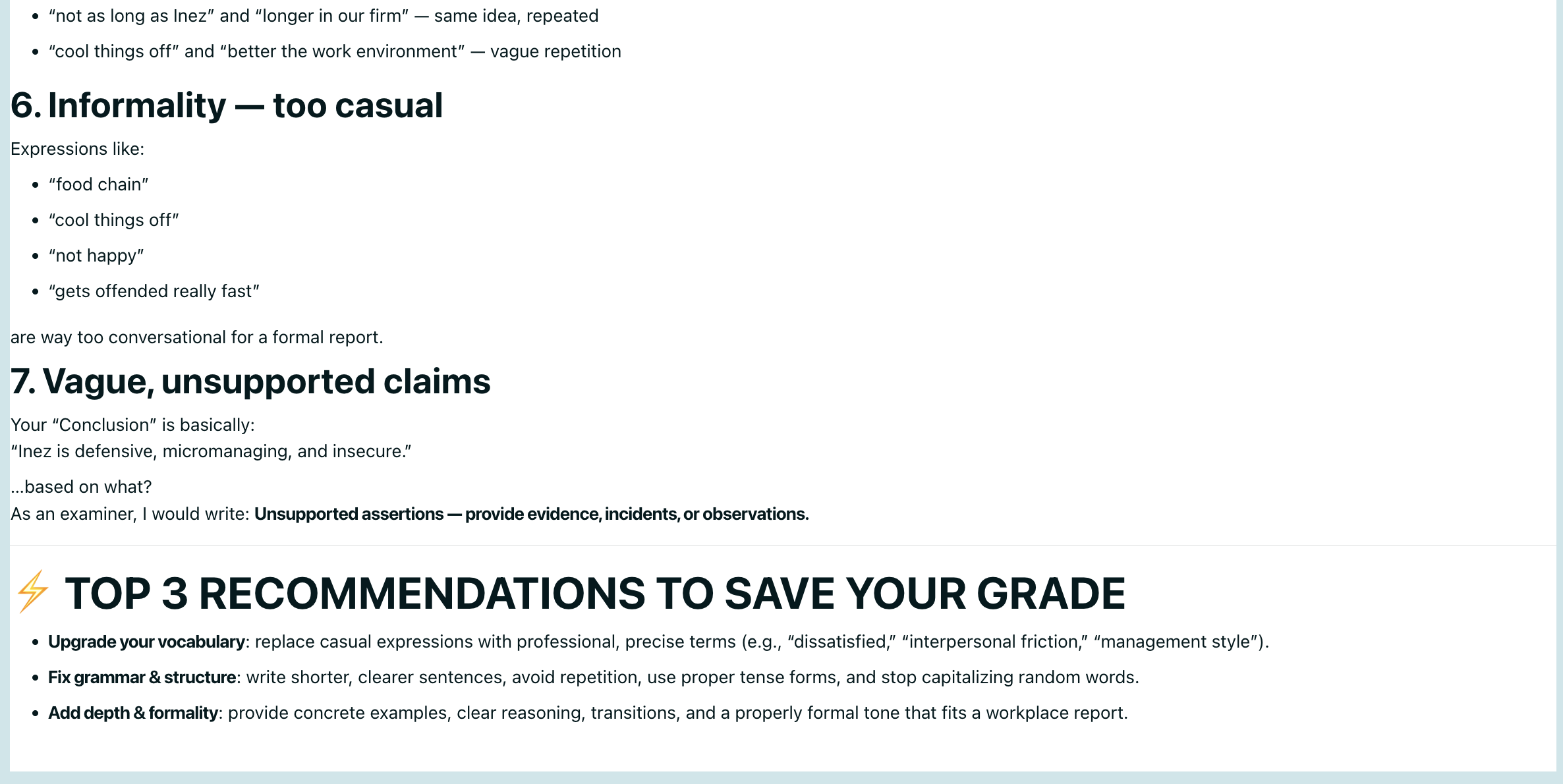
The AI said things like:
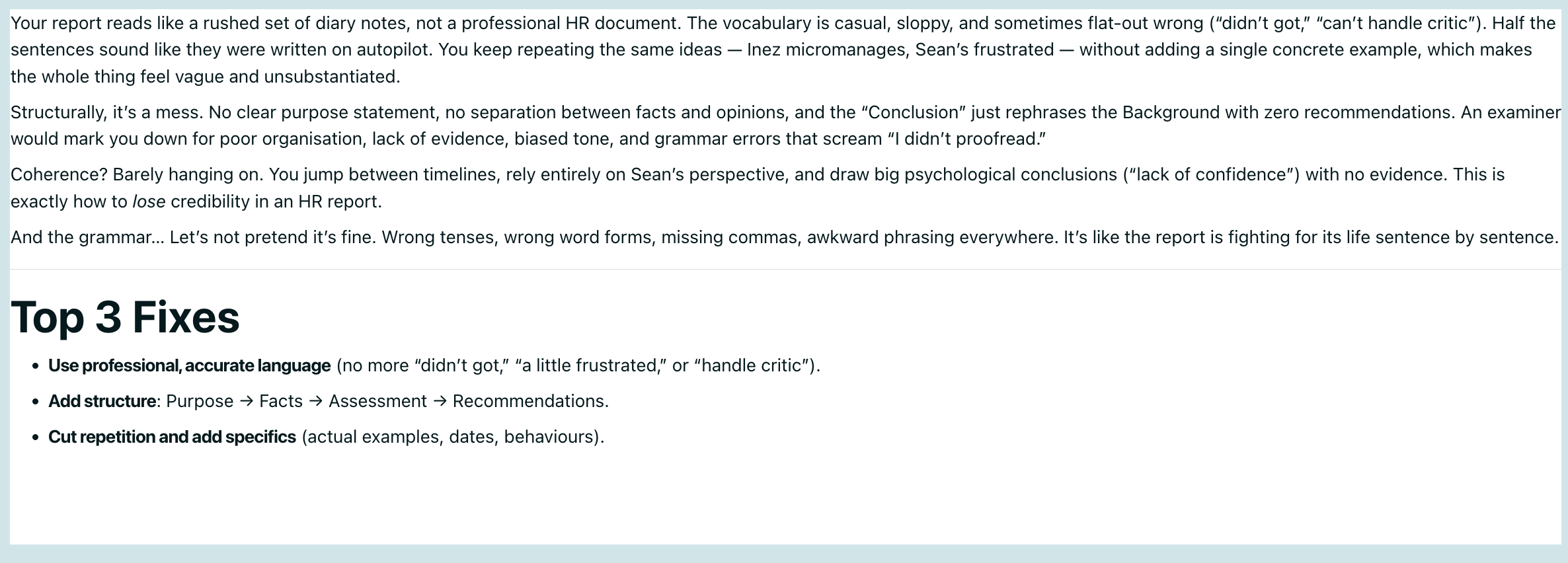
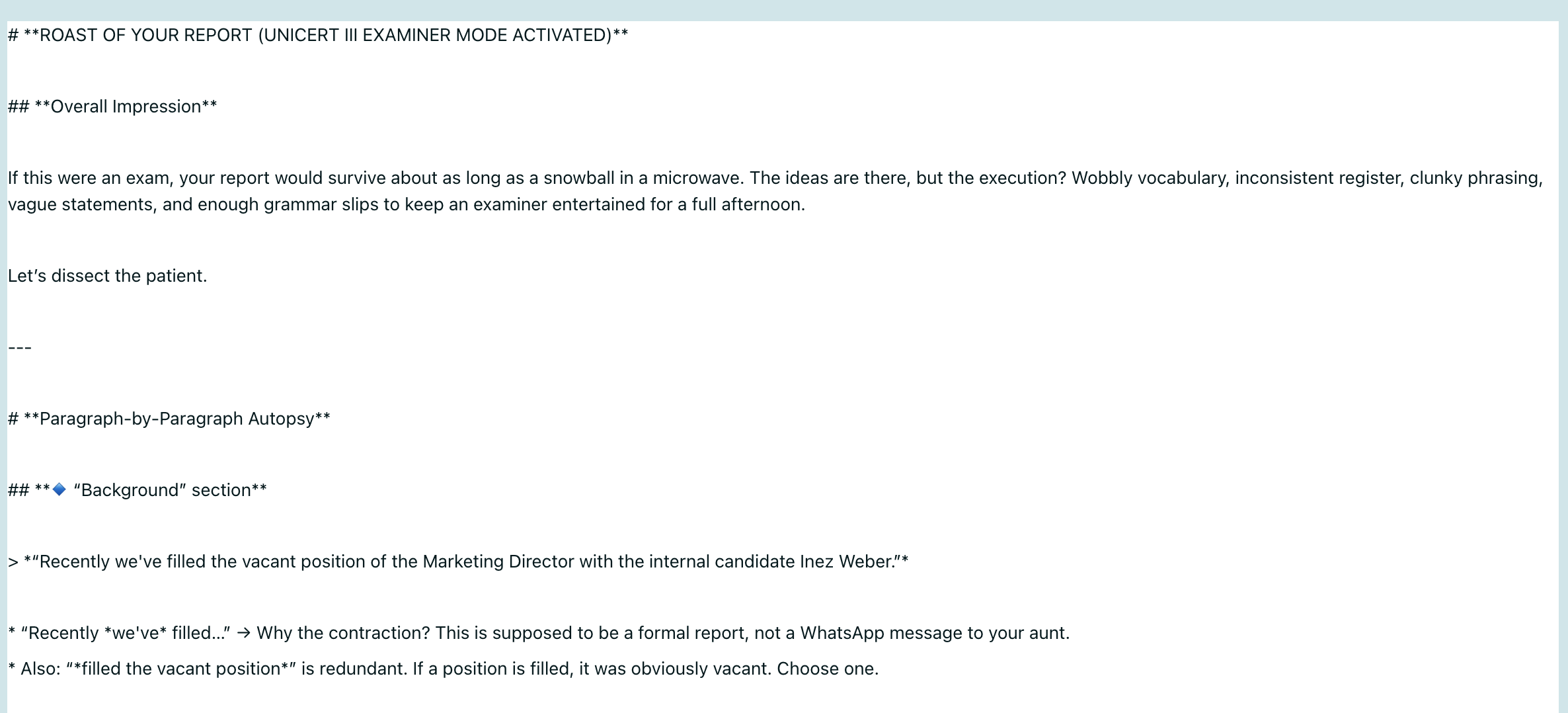
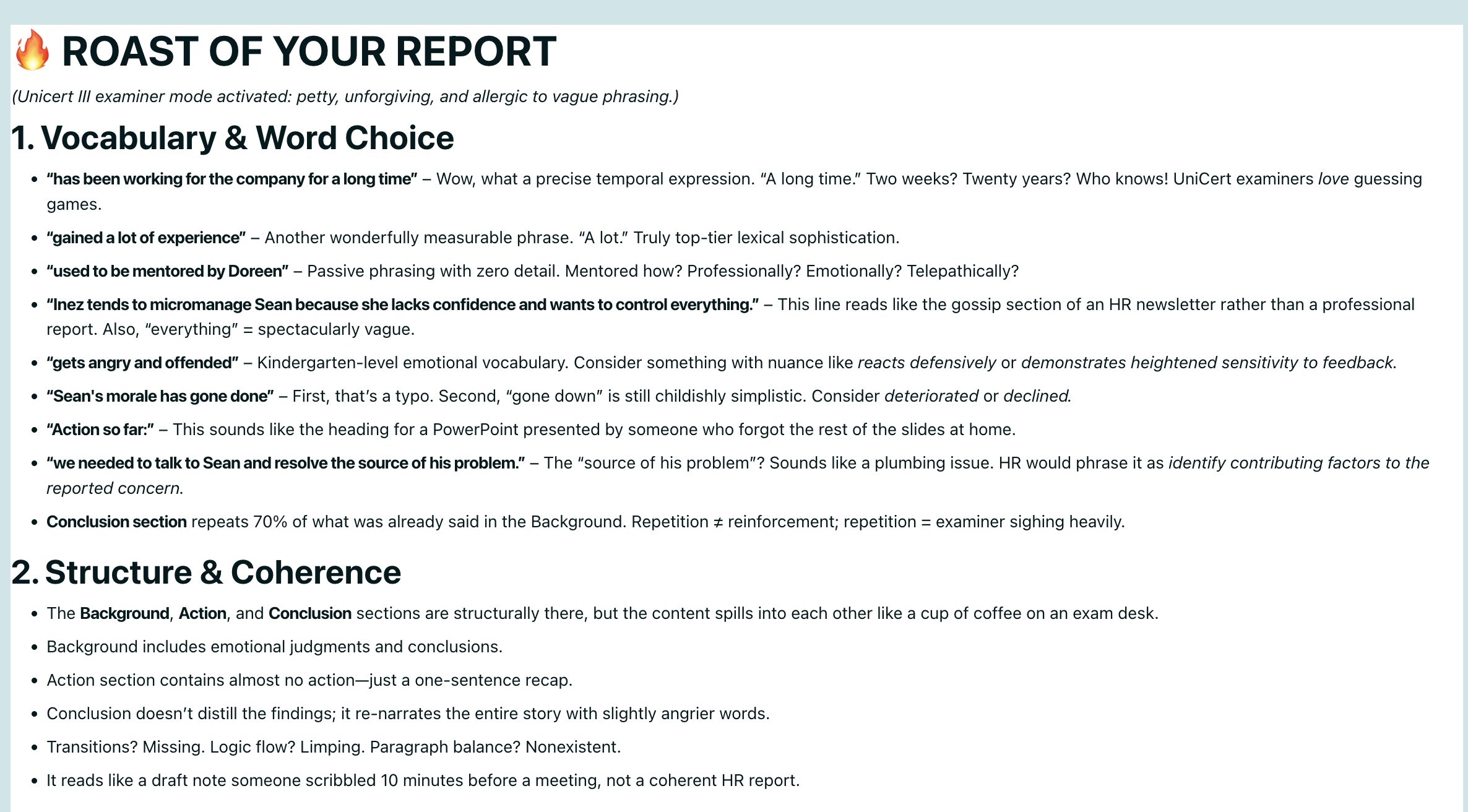
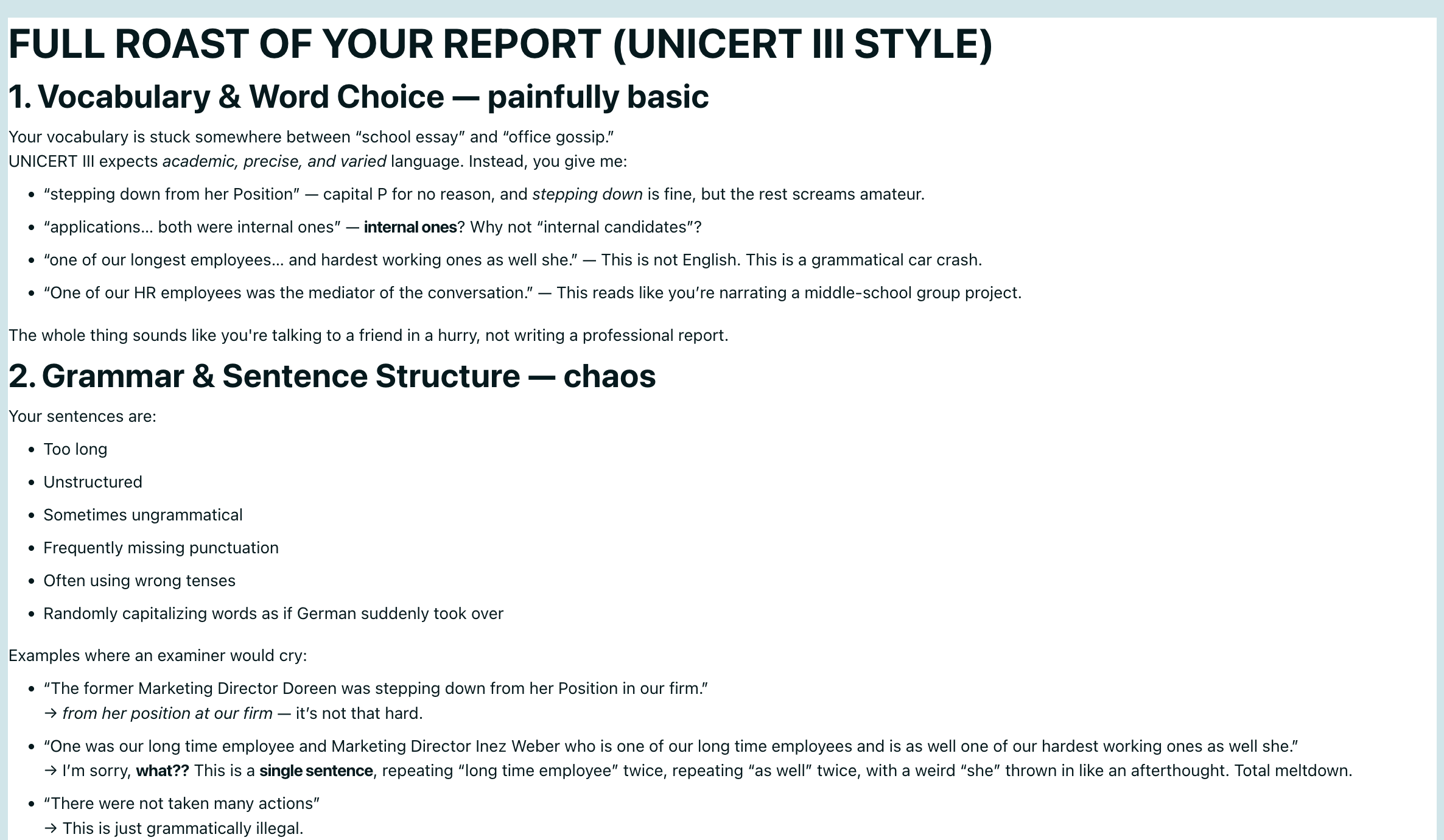
"This isn't a report—this is a WhatsApp summary."
"Your report reads like a rushed set of diary notes, not a professional HR document."
"Coherence? Don't know her."
Here are some examples taken directly from my course:
Round 2: The Revision
After the first roasting session, students wrote a full 400-word report on a different topic. They had specific, criteria-aligned feedback fresh in their minds. They knew exactly what to avoid and what to aim for.
For the second round, I adjusted the prompt to compare both pieces of writing:
The Prompt
You are a UNIcert® III examiner. The student has now completed TWO versions of
their report. Compare both pieces of writing and provide BRUTALLY HONEST feedback.

Use the UNIcert III assessment criteria:
- Content & Task Achievement
- Organization & Coherence
- Vocaulary Range & Accuracy
- Language Control

First version (200-250 words):
[first draft inserted here]

Second version (full 400-word report):
[second draft inserted here]

In your feedback:
1. Compare the two versions directly
2. Acknowledge improvements (if any)
3. Point out persisting problems with sharp, specific examples
4. Use humor and sass, but keep it actionable
5. Give an overall verdict on whether they improved enough
6. Remind them what UNIcert III actually expects

Be direct. Be harsh. Be funny. But most importantly, be USEFUL.
The Verdict
The AI didn't sugarcoat anything:
"⚔️ OVERALL VERDICT
Yes, you improved. But not enough. Your second report is better structured and less chaotic, but it still contains errors that would make a UNIcert® examiner sigh."
"UNIcert® III expects academic precision. You give BuzzFeed English."
I was giggling the entire time I monitored their sessions.
Key Takeaways
1. Speed of Feedback
I could have never given feedback that quickly between drafts. The turnaround from first draft to roast to second draft to comparison happened in a single class session. This rapid feedback loop is one of the biggest advantages of using AI in writing instruction, students can iterate multiple times within one lesson instead of waiting days or weeks for teacher feedback. They can take actionable steps.
2. Honest Feedback Without Emotional Impact
Honestly? I'd never say some of those things to a student's face (even though I sometimes think them). The AI could be brutally honest without the interpersonal dynamics getting weird. Students took it as a game, not a personal attack. This psychological distance can be pedagogically valuable.Sstudents sometimes need direct feedback without filtering, and AI can deliver that without damaging the teacher-student relationship.
3. Criteria-Aligned Precision
Because the prompts explicitly referenced the UNIcert® III assessment criteria, the feedback was funny, and was specific and actionable. Students knew exactly what standards they were being measured against. This builds assessment literacy: students learn to evaluate their own work against clear criteria, a transferable skill beyond this single task.
4. Student Agency and Motivation Through Choice
By letting students choose the roast, they had ownership over the experience. They wanted to see what it would say. And that made all the difference in how they received the feedback. Making feedback feel like a game, removed some of the anxiety typically associated with writing assessment. They were more willing to take risks and more open to criticism when it came wrapped in humor.
Keep in mind…
Here's what I need to emphasize: As a UNIcert® examiner myself, I know we don't look for perfection in the exam.
We assess student writing as a draft (which it is). The AI was much harsher than any examiner would be in the actual assessment (at least at my college- don’t know how it would be for others). I don't want students walking away demotivated or with the wrong impression of what's expected of them for the real thing.
That's why it’s important to debrief this activity, and put the feedback in perspective. Highlight that the point was to give them a low-stakes space to get immediate, critical feedback that could push their writing forward without the pressure of a grade hanging over them.
Over To You
I'd love to hear from you:
Have you experimented with AI for writing feedback? What worked? What didn't?
How do you balance speed and quality in feedback? Especially when you're teaching multiple classes or working with large groups?
Would your students choose "brutal honesty" or "gentle feedback"? What does that tell you about their readiness for critical input?
How do you help students distinguish between formative feedback (which can be harsh) and summative assessment (which should be fair and criteria-based)?
Drop your thoughts, experiences, or questions in the comments. Or better yet, if you try this approach with your own students, let me know how it goes!
Mariana teaches languages in higher education and writes about AI, pedagogy, and the messy, wonderful reality of language classrooms at marianaslearning.space.