
How to Host a Fireside Chat in Your Adult Language Classroom
I had a video planned. You know the kind, from the textbook, decent enough, does the job, students watch it, you discuss it, everyone moves on. But I knew someone who fit our unit topic perfectly, so I thought: why not just ask her to come?
My C1 class is in the middle of a lesson called “The Entrepreneurial Mindset”. Instead of watching random CEOs on the screen, Dr. Nancy Wang, co-founder and CTO of FluenTea, came to talk to my C1. She sat with us, my students ran the conversation, and it turned into one of those sessions that just make me happy because everyone is involved, engaged and gets so much from it.
This post is a practical walkthrough of how I set it up (what happened before, during, and after) plus how to adapt the whole thing for online classes.
What Is a Classroom Fireside Chat?
A fireside chat is an informal but structured conversation with a guest, led by student moderators rather than the teacher. The term originally referred to Franklin D. Roosevelt's radio broadcasts in the 1930s, informal, direct addresses to the American public, designed to feel like a conversation rather than a speech. It was later adopted in the tech and business world for relaxed on-stage interviews at conferences. In a classroom, it works the same way: intimate, conversational, and led by questions rather than a script.
In a language classroom, it's a format that bridges two goals at once: authentic listening and speaking practice, plus meaningful content engagement. For adult learners especially, hearing from a professional whose experience connects to what they're studying creates a depth of motivation that's hard to manufacture.
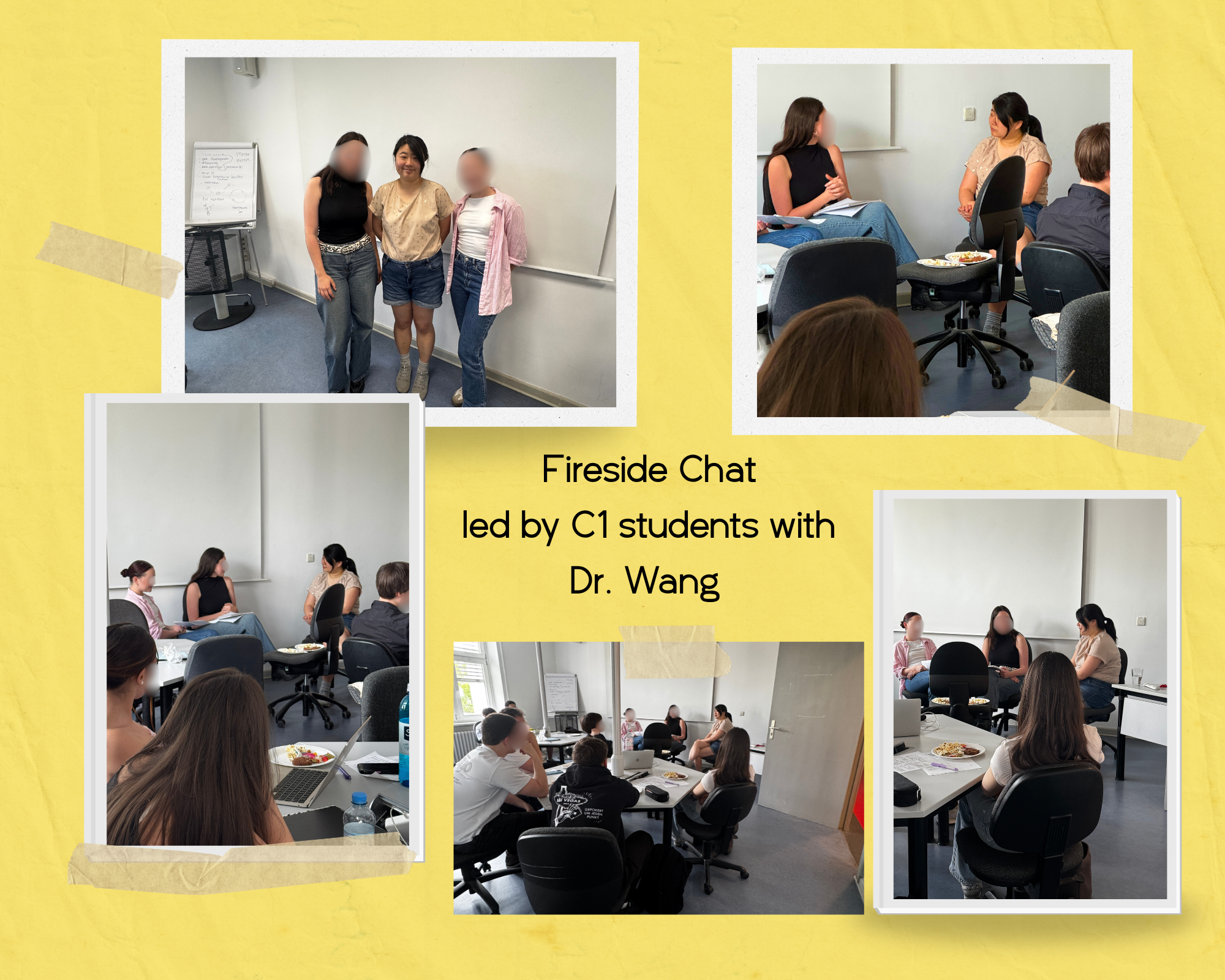
A scrapbook-style photo collage on a yellow background titled "Fireside Chat led by C1 students with Dr. Wang." Five photos feature students with blurred faces participating in an interactive classroom discussion and workshop with guest speaker Dr. Wang.
Why You Should Try It
1. Authentic language in context
Real speakers don't pause between chunks of vocabulary. They interrupt themselves, circle back, use idiomatic phrases, and express hesitation. This is the kind of input that is challenging, and pushes student’s listening competence.
2. Vocabulary retention through story
When students encounter a target word like gut instinct or setbacks in a textbook, it stays abstract. When they hear a guest describe the exact moment she left her job at Amazon without a financial safety net, and she uses those words to describe it, those words land differently.
3. Student agency and engagement
In a fireside chat, students lead the conversation. The teacher steps back entirely. Others can jump in with follow-up questions if they want to, but no one is put on the spot. That shift in ownership tends to change how the room feels. Exit ticket responses from my class after Dr. Wang's visit reflected this:
"I really enjoyed having someone who actually has a startup sitting in front of us and answering our personal questions."
"It felt like sitting at a talk show with genuine hosts and a special guest."
4. Meaningful listening, not passive listening
When students know there's a real conversation happening (one they can enter if they choose) they tend to listen differently. This is particularly valuable at higher proficiency levels where passive comprehension is already strong. Active, responsive listening is the real challenge, and a live guest creates the conditions for it.
How to Set It Up: A Step-by-Step Guide
Step 1: Find the Right Guest
Former students, colleagues, LinkedIn connections, or professionals in fields your learners care about are all good starting points. They simple requirement is they need to be relevant to your unit and willing to speak candidly.
A few things to look for:
Someone whose experience connects to your unit topic. They don't need a dramatic story, just something real to say
Availability for 45–75 minutes
Comfort with being recorded (if you plan to)
Brief your guest beforehand. Let them know the language level of the group, the unit topic, and that students will be asking questions. If they want to, share two or three sample questions so they can prepare mentally without over-scripting.
Step 2: Embed the Guest's Content Into Your Unit
When I started thinking about this chat, I wanted to make sure my students got the most out of it. Given that my class is 180 minutes long, I thought it would maximize our time if I could somehow merge our unit's content with preparation for the chat. So instead of treating the guest as a standalone event, I designed her into the unit.
For the session with Dr. Wang, I took her biography and embedded the unit's target vocabulary directly into it. Students read the bio as part of a jigsaw activity: Student A got her early years and academic background; Student B got her corporate career and startup journey. They had to retell each other's sections from memory, then collaborate to write sentences linking her life events to the vocabulary.
By the time Dr. Wang walked in, every student already knew who she was, had used the unit’s vocabulary in context, and had invested in her story. Questions came much more naturally as a result (more on questions below).
Step 3: Prepare Student Moderators
Ask for volunteers to host the conversation. I opened it up to four students and two came forward. Give them this brief:
Your job is to keep the conversation going
Listen actively, build on what she says, don't just read the next question
You can invite classmates to ask questions
It's okay if things go off-script as that's often when it gets interesting
I sent them some questions to get them started, and shared the student-generated questions in advance (see Step 4) so they can organise and prioritise. Let them rehearse a brief introduction of the guest.
Step 4: Generate Questions After the Pre-Reading
In my session, students came up with their questions right after the jigsaw reading activity, which meant they already knew who the guest was, what she'd done, and had discussed her story with a partner. The questions they produced were much more focused because of that. Instead of "tell me about your career," they were asking about specific decisions, doubts, and surprises.
I collected the questions, gave them to the moderators to select and sequence, and they took it from there.
Step 5: Create the Environment
This matters more than it sounds:
Rearrange seating so it feels less like a classroom (a horseshoe or circle works well)
I brought snacks, and some students did as well
If you have a screen, play a video of a nice and cozy fireplace, even if it summer! (I forgot this step, though)
Have the moderators greet the guest and introduce them
Step 6: Debrief and Collect Feedback
An exit ticket after the session serves two purposes: it gives you data, and it gives students a moment to consolidate what they heard. I asked three questions:
A brain dump (anything that stuck from stories, and advice, to surprises), with a prompt to use target vocabulary naturally
The main takeaway from listening to the guest
How it felt to step away from the usual class routine
Any outstanding questions they still had for the guest
The responses were thoughtful and, in several cases, personal. One student wrote about being surprised that the guest had no regrets leaving stability behind. Another noted they'd never considered how hard it is to reach actual customers.
If you promised to pass follow-up questions to your guest, do it. It extends the learning experience and models professional follow-through.
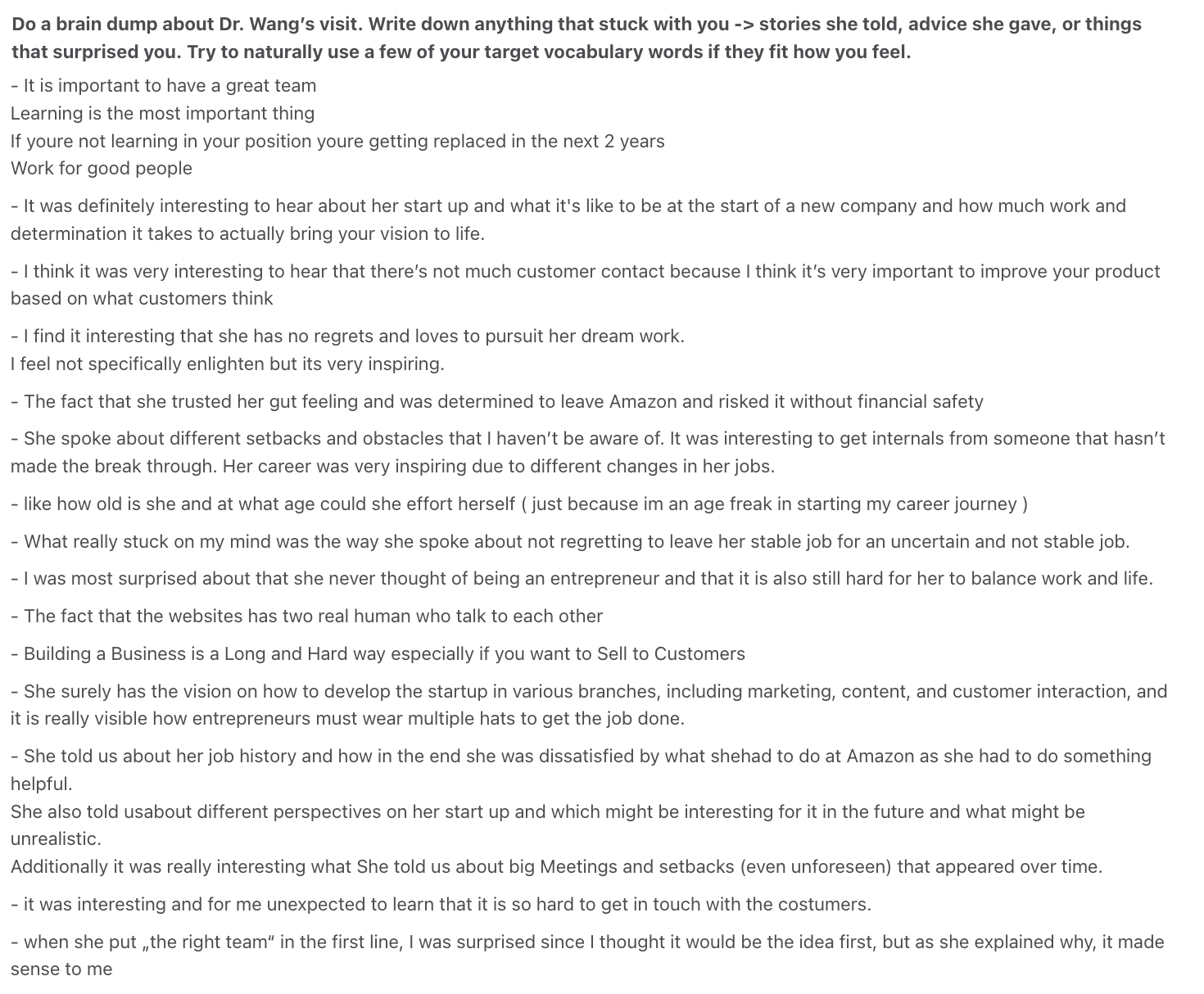
Image showing a digital document or screenshot containing bulleted notes and a "brain dump" exercise about a guest visit from Dr. Wang. The text captures key takeaways, personal reflections, and career advice regarding startups, entrepreneurship, and leaving a corporate job at Amazon.
Adapting This for Online Classes
A fireside chat doesn't require everyone to be in the same room. Here's how to adapt it:
Platform: Zoom or Google Meet work well. Use the gallery view so the guest can see all students, not just a speaker spotlight.
Moderators: Same role as in person. Brief them on muting/unmuting protocols and how to manage the chat if students type questions there.
The chat box: This becomes a low-stakes space for students to respond in real time, from reactions, to follow-up thoughts, and vocabulary they noticed. Assign one student to monitor it and flag relevant comments to the moderators.
Breakout room warm-up: Before the guest joins, put students in pairs for five minutes to review their questions and share what they remember from the pre-reading. This settles nerves and activates the vocabulary before the main event.
Recording: With everyone's consent, recording a session is straightforward and gives you a resource to use for follow-up listening work.
Asynchronous extension: If students couldn't attend live, the recording plus the exit ticket can be assigned as homework. You can also create a short reflection task for the recording.
Is This Worth the Preparation Time?
100%, yes. The preparation is lighter than it looks once you have the framework. Most of the work is front-loaded: finding the guest, designing the pre-reading, and briefing the moderators. The class itself, if you've set it up well, runs on its own momentum.
Whatever you do, don’t skip the exit ticket.
"It was really interesting, not just reading about startups, but actually hearing from a real person, so we could ask live questions. That's not possible with a text."
For adult language learners, that feeling of relevance is often the difference between retention and forgetting.
Mariana runs Mariana's Learning Space, where she creates resources and workshops for language educators. If you're a teacher interested in working together, you can find out more at marianaslearning.space/work-with-me.